
As things stand, millions of people worldwide use Firecracker. In fact, this technology is now relied on to handle trillions of requests each month, making it a valuable tool for hundreds of thousands of Amazon Web Services (AWS) customers. But Firecracker is not just for AWS users. Because it is open source, anyone can run it, whether on their developer laptop, in a data center, or with a cloud provider. As such, many developers and organizations have turned to this tool to create their own secure services and platforms. But why has it gained so much traction?
What Exactly is Firecracker?
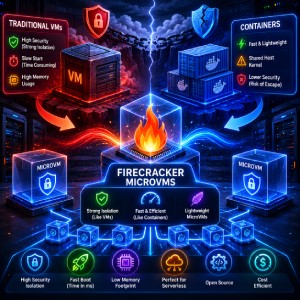
To understand the hype behind this technology, we have to go back to the gap it addresses in cybersecurity. You see, in the traditional sense, you have two choices when you want to run code in the cloud. Option 1 requires you to use a virtual machine. While this provides you with a high level of security because of the complete isolation, it also costs you a lot in terms of time and memory. Option 2 relies on containers. You get the advantage of speed and low memory usage, but you now have to share the same host operating system kernel. Unfortunately, this makes them less secure because if someone manages to breach one container, they can use that vulnerability to attack the connected computers.
Firecracker, which is an open-source tool built by Amazon Web Services (AWS), allows you to enjoy the best of both options by creating micro virtual machines (microVMs). With microVMs, you get lightweight virtual machines that offer you a high level of isolation and security, like traditional virtual machines. And they also introduce the fast speed and efficiency of software containers.
Why Firecracker Ranks High In Security
Firecracker uses microVMs to not only speed up your operations but also keep you and other users secure. And it all comes down to the genius of its whole setup. How?
To start with, your code exists in its own operating system. That means that if the code takes over because it is malicious, it only affects that sandbox and not the entire server. Secondly, because Firecracker only allows basic networking and basic storage, it limits the number of features that attackers can exploit. And third, Firecracker isolates the entire microVM by taking away the permissions it could use to interact with the rest of the physical machine. In doing so, it creates several important boundaries that attackers must get through if they want to exploit a system.
Thanks to all of these features, Firecracker has become a mainstay in cloud and serverless environments. Take serverless computing, for example. In an environment like AWS Lambda, code only runs when users trigger it, such as by clicking a button on a web page, and then it immediately shuts down. But since millions of people can trigger the code at the same time on the same cloud computers, there is a risk that one customer’s code could be used to spy on another’s. Firecracker prevents this by setting up tiny dedicated virtual machines for every piece of code and then destroying them a millisecond later.
Vulnerabilities in Firecracker and How Security Teams Are Navigating Them
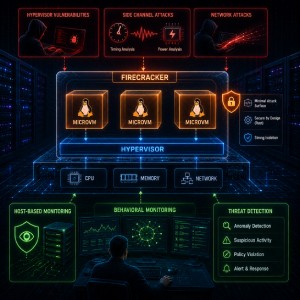
While Firecracker is a highly secure technology for organizations with virtual environments, it still has some loopholes that attackers can exploit. First among these is the hypervisor, which is the software that manages the virtual machines. If an attacker is able to find a bug in the Firecracker code, they can find a way into the host computer. Luckily, Firecracker mitigates this risk by using Rust as its programming language, but this is still something worth noting.
Another common risk is the possibility of side channel attacks due to the shared physical computer chips. If attackers can measure variations in timing or power consumption, they can figure out the workings of other microVMs and target them. Hackers are also known to target the code that moves data from the physical network into microVMs. Unfortunately, such attacks can expose data belonging to different apps and can take place so fast that they can go unnoticed.
Thankfully, most security teams that are integrating Firecracker are well aware of these risks, and since monitoring activity within the microVM often proves challenging, they have focused their efforts on monitoring the host system to look for suspicious activities in the microVMs. They often rely heavily on behavioral monitoring through detection systems that flag any abnormal behavior from functions within the system.